



Over the years, I've given panel presentations, hosted showroom events, led live Instagram sessions with designers, and held more one-on-one calls with clients than I can count. And no matter the audience — whether I'm speaking at a trade event or working through a bedroom spec with a designer in California — the single most common question I field is always some version of the same thing:
"I sleep hot, and my partner sleeps cold. How can we both be comfortable in the same bed?"
It's the question that never goes away. And I love it — because the answer isn't what most people expect.
Why Most Bedding Doesn't Actually Solve This Problem
The instinct when you're trying to solve a temperature conflict is to look for a single product that splits the difference. Something not too warm, not too cool. A compromise duvet. A "neutral" fill.
The problem is that a compromise at the top layer doesn't address what's actually happening beneath you. Temperature regulation in a bed isn't just about what's on top of you — it starts at the foundation, with what's underneath you, before the sheets and the duvet even come into play.
I always tell people: you're not going to solve a temperature conflict with one product. What works is a layered approach, built from the ground up. Each layer has a job. When you build the bed right, both sleepers can genuinely be comfortable — not in spite of each other, but in the same bed, at the same time.
How to Build a Full Temperature-Balanced Bed
Think of building a bed the way you think about getting dressed. You can put on the most beautiful outfit in the world, but if what's underneath isn't right, nothing looks or feels the way it should. A temperature-balanced bed works the same way — it starts at the foundation and builds up from there.
Here is the layered system I recommend for couples who have been fighting over the thermostat for years:
- The Foundation — Wool Mattress Topper: regulates temperature at the surface level before anything else goes on
- The Sheets — Percale: open-weave breathability that lets both sleepers stay comfortable
- The Top Layer — Silk Duvet: responds to each sleeper's body temperature. Meaning, if you are cold, it provides warmth. If you are hot, it keeps you cool.
- The Pillows — Choose Down, as it is an organic fiber that will adjust to your body temperature.
Each decision builds on the one before it. By the time you get to the duvet, you've already done most of the work.

Wool Mattress Topper

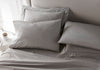
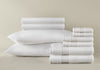
Boutique Percale Sheet Set

Silk Filled Duvet Insert
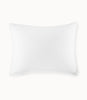
Canadian White Down Pillow
The Foundation: Wool Mattress Topper
Before we talk about duvets or sheets, we need to talk about what goes under all of it — because that's where temperature regulation actually begins.
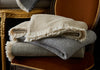
Our Wool Mattress Topper is the first piece I recommend when someone brings up the hot/cold problem. What makes it work is the wool itself. This is US lamb's wool — sheared from young sheep, which means it's naturally soft, resilient, and full of what I'd describe as a coil.


Wool Mattress Topper
Think of it like this: each fiber has a natural curl to it, the way curly hair coils. That coil creates a springy, lofted pile — and it's that structure that does the work. The coil creates separation between your body and the mattress surface, allowing air to circulate between them.
That airflow is what keeps the sleeping surface from retaining heat, since our mattresses are typically the core of the bed's heat.
When you touch and feel it in person, you are immediately drawn to its plush softness, but this product is more than that. But beyond the feel, what you're touching is engineering.
The fibers are young and resilient. They stay clean, stay soft, and because of that springy coil, they hold their loft for years. The topper sets a breathable, neutral foundation that benefits both sleepers — not just the one who runs warm. And it's doing all of that before you ever pull a sheet over yourself.
Oprah awarded our Wool Mattress Topper "Best Temp Regulating Topper," and as I always say, we listen to Queen Oprah.
The Sheets: Percale for Hot Sleepers
Now that the foundation is set, let's talk about sheets — and specifically, why the weave matters so much more than most people realize. Here's what's actually happening at the fiber level:
Percale sheets feature an open-weave construction — one-over, one-under — that allows air to move freely between the threads. That airflow is what gives percale its signature feel: crisp, cool, and breathable.

Boutique Percale Sheet Set
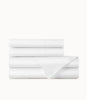
Lyric Percale Sheet Set

Nile Egyptian Cotton Sheet Set
Sateen sheets, by contrast, are a tighter weave. More threads packed together means less space for air to pass through, which is what makes sateen warmer — and what gives it that smooth, lustrous finish.
This isn't a new discovery. Traditionally, people slept on sateen in the winter and percale in the summer. The weaves were designed for different seasons. That logic still holds today.


Soprano Sateen Sheet Set
What I've found in years of working with clients is this: people who sleep cold are rarely searching for a solution — they're happy to pull on another layer.
But people who sleep hot? They're on a mission. They're the ones doing the research, trying everything, frustrated that nothing has worked. Percale speaks directly to them, because breathability is exactly what they've been missing.
For a hot/cold split, percale is the right call. The breathability serves the warm sleeper without making the cold sleeper uncomfortable.
The Top Layer: Silk Duvet
If the wool topper is the foundation answer to the hot/cold problem, the Silk Duvet is the top-layer answer — and it's the piece that makes one duvet work for two completely different sleep styles.

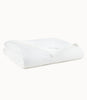
Silk Filled Duvet Insert
Silk is inherently temperature-regulating in a way that most fills are not. Unlike down, which insulates by trapping warmth in its clusters, silk responds to your body's own heat. It breathes. It adjusts. It works with each sleeper individually rather than holding a fixed temperature that one of you will inevitably fight against.
For the person who sleeps hot, silk doesn't pile on heat the way a heavier fill would. For the person who sleeps cold, it still provides the enveloping, comforting weight of a real duvet — the kind that actually feels like something when you pull it over you.
When couples come to me with this problem, the silk duvet is always part of the answer. I come back to it again and again because it actually solves the problem rather than managing it. It's not a compromise. It's a material designed by nature to regulate, not insulate.
The Full System For Couples With Different Sleep Temperatures
- The full system: Wool Mattress Topper + percale sheets + Silk Duvet + Down or Down Alternative
- Pillow Inserts: Two different weights, one for each of you. Build it once. Sleep well — together.
A note on investment: these are not impulse purchases, and I don't pretend they are. But the things that are against your body every single night — what you sleep on, what you sleep under — are exactly where quality makes the most difference. Especially if you and your partner have two different sleeping styles.