



Shopping for the best luxury bath towels isn’t as simple as looking for “soft” and “absorbent” on the label. Towels described in nearly identical terms can feel—and perform—very differently.
Much of that difference comes down to three things: fiber, weight, and yarn construction. Understanding each can help you recognize what makes a towel exceptionally soft, absorbent, and well-suited to your preferences.
Key Takeaways
- Thread count tells you very little about a towel. It is a sheeting metric that is transferred over to bath linens, where it does not apply cleanly.
- Softness comes from fiber length and how the yarn is spun, not from a finishing treatment that washes out.
- Absorbency is largely a function of GSM, the weight of the fabric per square meter.
- Softness and absorbency pull against each other slightly, and good construction is what lets a towel deliver both.
- A coordinated towel set is more likely to maintain a consistent look over time than towels replaced piece by piece.
Why Some Towels Feel Better Than Others
Two towels can have similar specifications and still feel noticeably different. One may feel substantial and plush, while another feels thinner or less refined. The difference often comes down to the quality of the cotton, the construction of the yarn, and how the towel is woven.
Look Beyond Thread Count
Thread count is commonly used to describe sheets, measuring the number of threads woven into a square inch of fabric. Towels are constructed differently, so the same measurement tells you much less about how a towel will feel or perform.
A towel relies on its raised loops, or pile, to absorb water and create its characteristic softness and volume. Thread count does not describe loop density, loop length, or the quality of the cotton in those loops. A high number on a towel label is more for marketing than measurement.
Fiber, Weight, and Twist: The Three Variables
Three characteristics determine how a towel performs over the years of use:
- Fiber: the length and quality of the cotton staple
- Weight: the density of the fabric, measured in GSM
- Twist: how tightly the yarn is spun before it is woven
What Makes a Towel Soft
Lasting softness begins with the quality of the cotton and how its fibers are spun into yarn. A finishing treatment can make a lower-quality towel feel soft off the shelf, but that finish washes out within a few cycles, revealing the towel’s true texture underneath.
Fabric softener may create a softer feel, but it can leave a coating on the fibers with repeated use. This buildup can affect absorbency, so lasting softness should come from the quality of the towel itself.
Long-Staple Cotton
Cotton fibers vary in length, and longer fibers are particularly well suited to creating smooth, durable yarns. Long-staple cotton has fewer exposed fiber ends, resulting in a softer, more uniform surface that is less prone to pilling.
This combination of softness and strength also helps a quality towel maintain its feel through repeated use and washing, rather than relying on finishes to create softness when new.
Zero-Twist and Low-Twist Yarn
Yarn is spun by twisting fibers together. Tighter twisting produces stronger, denser yarn, common in inexpensive towels built for durability above all else.
Zero-twist and low-twist yarns create the plush, soft feel often associated with luxury towels. Longer cotton fibers are particularly well suited to these constructions because they can form smooth, strong yarns with less twisting.
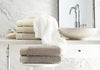
Peacock Alley’s Chelsea Plush Bath Towel uses zero-twist yarn to create a plush, lofty feel while maintaining the absorbency expected from a quality cotton towel.
What Makes a Towel Absorbent
A towel’s absorbency comes down to how effectively its fibers take in and hold water. Fiber quality, pile construction, and weight all contribute to how well it performs.
GSM: The Weight That Matters
GSM stands for grams per square meter. It measures the density of the fabric rather than its thickness, which is the most useful specification on a towel label.
- Lightweight towels around 300-400 GSM dry quickly and suit gyms or guest baths.
- Mid-weight towels, with GSMs of 500 to 600, balance absorbency against drying time for most households.
- Above 700 GSM, towels hold considerable water but take noticeably longer to dry.
The Chelsea Plush sits at 600 GSM, the upper end of that practical middle range.
The Softness/Absorbency Tradeoff
These two qualities are related but not identical, and optimizing purely for one can undercut the other.
A very loosely spun towel feels wonderful and may hold less water than its weight suggests. A dense, heavy towel absorbs beautifully but can feel stiff against your skin. Zero-twist long-staple cotton balances this dynamic with open loops that absorb efficiently, while the fiber quality keeps the surface soft.
Building a Complete Bath Collection
Towels bought individually over several years rarely look coordinated, even in one color. Dye lots shift, and wear patterns differ between an older towel and a new one.
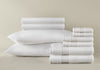
A full set generally includes bath towels, hand towels, washcloths, a bath mat, and a robe, bought together for consistent color and wear. A bath rug and bathrobe in complementary tones do more for a bathroom than one upgraded towel.
Luxury Bath Towels at Peacock Alley
Since 1973, Peacock Alley has applied a strict long-staple cotton standard across its fine bed and bath collections.
The Chelsea Plush combines that cotton with zero-twist construction at 600 GSM, finished with a wide-ribbed woven border and a hanging loop. Bath towels measure 30 by 54 inches, while bath sheets measure 34 by 60 inches for more coverage.
Caring for Luxury Towels So They Last
Good towels reward correct laundering, and the most common mistakes reduce absorbency directly.
- Wash before first use. A manufacturing finish limits absorbency until it washes out.
- Skip the fabric softener. It coats fibers with a water-repellent residue, working against the towel's whole purpose.
- Use warm or cold water and moderate heat. High heat breaks down cotton fibers over time.
- Do not overload the dryer. Loops need room to fluff.
Vinegar in place of softener occasionally strips built-up residue and restores absorbency in older towels.
Conclusion
The best luxury bath towels are identifiable before you ever touch them. Look for long-staple cotton, a GSM figure in a range that matches how you plan to use the towel, and yarn construction that the brand is willing to specify.
Explore Peacock Alley's bath towel collection.
Frequently Asked Questions
Which towel is super absorbent?
Absorbency tracks closely with GSM. Towels at 600 and above absorb the most, particularly in long-staple cotton. Anything advertised as absorbent without a stated GSM is worth questioning.
Where can I find super soft bath towels?
Look for zero-twist or low-twist towels made from long-staple cotton, like Peacock Alley’s Chelsea Plush collection
Which towels are the best quality?
Quality shows up in these specifications:
- Long-staple cotton
- GSM
- Yarn construction
Vague descriptions make it harder to judge fiber quality and yarn construction.
What type of towels do 5-star hotels use?
Hotels typically choose mid-weight cotton around 500-600 GSM, since these towels need to withstand industrial laundering. Home towels don’t suffer as much wear and tear, so you can prioritize softness more heavily.